Study Helps
This page last updated:
11/27/2007 11:03 AM
Bible Search Aid | The
Whole Bible Seekers Forum
The
Weekly Portion (Parasha) |
Talmud - Correcting
Errors
The 613 Mitzvot (OT) |
1,050 Mitzvot (NT)
Dead Sea Scrolls
Calendar | Software
| Logos |
Accordance
Hebrew Names
for Bible Books |
Jewish
Encyclopedia
Myths and Facts
of the Arab-Israeli Conflict
Bibles |
Commentaries |
Creation |
Genesis |
Hebrew Language
History |
Interpretation |
Jesus |
Judaism
Letters and Numbers
| Paul |
Sanctification
The Tanakh |
Theology |
Translations |
Tzitzit
more coming...
Printable versions of most articles are available using the Adobe
Acrobat Reader. Click on the 'Printable' links to print. A
free version of the Reader is available by clicking
HERE.
Articles without a 'Printable' link may still print, they may just be in
other formats on other web sites, or they may already be in a format
that the Reader will print.
Below is a free
Bible search aid. While we do not agree with many of the
teachings of this site, and we do not endorse any of the advertising,
still this is a handy tool for those who may not have a software package
of their own. We had to put the box in exactly like they have it
or it wouldn't work (reasonable in view of the hacking attempts out
there). To use it just pick your book, put a search word in the
box, and pick the number of occurrences you want to see and hit the
Search button. Use it with our blessings and our cautions.
Some of the links above will
take you to a place on this page, some will take you to other pages on
this site, and some will take you directly to other sites. If you
know of a study help that would be of benefit to us or other visitors to
this site then please email us with the information.
All books and tapes have been
reviewed by us and we rate them as very good. If we haven't
directly reviewed the book or tape then it has been recommended to us by
someone who's opinion we trust. Some books or tapes are very hard
to categorize and might belong in under several headings. But we
did the best we could to place them where they would be easiest to find.

A fun and informative tool to add to your study helps is the Whole
Bible Forum. You must register by filling out a simple
form, then the registration must be activated (we get an email then
email you back) before you can post replies or topics. The forum
community is a good group of people who are gentle and kind and want to
help you learn and to learn from you.
When you decide to take the plunge and register, you will be able to
read and reply to other's comments and post topics of your own. This is an
excellent way to supplement your own study program and have your
thinking challenged. Click
HERE to find out what the Forum Rules are and a little about how to
use the forum. The forum is a good way to practice
community and get a broader insight into our Father's Word. We
encourage you to register and participate.
Also known as the Parasha,
which is Hebrew for portion, the Weekly Portion is a method of splitting
up the first five books of the Bible (the Torah) into weekly sections or
portions to help with reading the Word on a regular basis. There
is a three-cycle and a one-year cycle. We like the one-year
because we think we need to read as much as possible. Others like
the three-year cycle because the portions are smaller and reduce the
amount of material that is covered. Either way, it is a good idea
to read the Word on a daily basis, and these schedules simply help with
pacing.
We have a booklet that we
make of the one-year cycle. It is only available to active,
registered Whole Bible Forum members though. To register read the
section above and go to the page explaining how. The chart is a pdf file (for Adobe Reader)
which can be printed out.
You can
also try the Whole Bible forum, which has
a section called Reading Cycle for commentary on each part.
This is a list of the
commandments found in the Torah according to one famous rabbi who is
called Maimonides (my-moan-ee-des). Mitzvot is a Hebrew word for
commandment. He compiled the list and grouped them into books or
sections by subject. This is not the only list, nor is it perhaps
the best list, but it is handy for a quick reference on what the Torah
has to say on particular issues. The page is a little long so it
might take a some extra time to download if you have a regular modem.
But section headings are at the top if you just want to browse to a
particular subject. Click below to connect to the page.
The 613 Mitzvot |
Printable Version
1,050Mitzvot
(NT)
Oh, boy. As if 613
weren't enough, one person has found as many as 1,050 commandments in
the New Testament. And some Christians think the Law was
eliminated! Even if you don't agree with the person who compiled
the list (Finnis Jennings Dake), it should nonetheless sharply change
your perspective on whether or not there is more to the Christian life
than merely raising your hand and saying "I believe in Jesus."
We started out with one
command in the Garden and wouldn't do that. Then we got the list
of 613 from Mt. Sinai and wouldn't do those. Now we have 1,050 and
still refuse to obey. What next?
New Testament Commandments |
Printable version
This table gives you the
English names of each of the books in the Bible and their Hebrew
equivalents. Many times when reading articles or books the authors
use Hebrew names in an effort to reconnect the reader with the Hebraic
origin of the Bible. Unfortunately, sometimes they get so used to
using them they forget to provide the English translation. Some
authors think the Hebrew names are more descriptive, and some are maybe
a little too arrogant. Anyway, this table will help you learn the
names or act as a reference if you need the translation and it wasn't
provided.
Hebrew Names for Bible Books |
Printable version
This is a handy reference
tool for a Jewish perspective on subjects in the Tanakh (OT), Jewish
culture, and Jewish history. It is the online version of the
printed edition that was last published about 100 years ago, so it
doesn't have more recent information. But it still has a great
deal of helpful articles, especially if you need to write a paper for a
class. Click on the link to go to the index and begin searching.
www.jewishencyclopedia.com
If you have trouble with
display or font problems, be sure to click at the link near the top of
the page Having
font/display problems? This will give you instructions on
loading a free Unicode font that will help with displaying all the
special characters they use.
American-Israeli Cooperative Enterprise
This is so good and so
appropriate that it deserves a heading by itself on our site. The
title of this section is also the title of a book, and the publishers (AICE)
have their own web site. Both are perhaps the single best
references for information on the continuing conflict between Israel and
the Arab countries. The information is organized under subject
headings so you can read (or surf) according to whatever question is on
your mind.
Below is the web site
link, which presents new information all the time to supplement the
Myths and Facts already covered, and which also has the book for sale.
Buy the book and help to clear up the myths and simplify the facts of
the conflict for your friends, neighbors, or church buddies. The
author is Mitchell G. Bard.
The web site also has many
other interesting books and programs to promote the already substantial
benefits that America receives through our alliance with our Jewish
brothers and sisters.
www.jewishvirtuallibrary.org
This is essentially a
commentary on the Jewish Oral Law, which in turn is a series of rulings
and interpretations on the Torah (first five books of the Tanakh (OT)).
It was put together by Jewish people over a long period of time, but was
pretty much finished by about the fifth century. There are
different parts but they are all generally referred to as the Talmud.
The Mishna (meesh-nah)
is the section containing all of what was formerly called the Oral Law,
and was put together by Rabbi Judah around the second century. It
has 63 parts called tractates, which are grouped under six headings
called Orders. The six orders include Zera'im (it means
Seeds, and includes a famous tractate called Brakhot (or
blessings), Nezakin (Damages), Nashim (
Women), including laws of Kiddushin or marriage and Gittin
or divorce), Kodashim (sacrifices and ritual slaughter),
and Taharot (laws of purity and impurity). One
of the 63 tractates is Pirkei Avot (peer-kay ah-vote), meaning
roughly 'Ethics of the Fathers,' which is a collection of the rabbi's
most famous sayings and proverbs. You will hear this tractate
referred to on occasion in your studies of Torah or the Law.
Jewish tradition holds
that the Oral Law was given originally to Moses at the same time as
Torah. It was subsequently handed down (you guessed it - orally)
with the written Torah until is was also written down by Rabbi Judah.
Many Jews still believe that the Oral Law is equal to the written Torah,
and in some cases over-rides Torah, a position with which this ministry
disagrees. We feel that the Oral Law should've stayed oral.
If God had wanted everyone to know the material contained in the Mishna,
He would've made sure it was included in the written Torah.
However, there is much to be gained from the Talmud and we do not
recommend throwing out the baby with the bathwater.
The Gemara
(gay-mar-ah, the word means 'rabbinic discussions') is the section
containing commentary on the Oral Law made by certain leading rabbis at
various times. Talmud and Gemara are also used interchangeably.
Part of the Gemara is called the Jerusalem Talmud and was finished
around 400 A.D., and the other part is called the Babylonian Talmud and
was finished around the 500 year-mark after the Christ. This
collection of writings and opinions is an unparalleled study resource
for the serious student, although a lot of it has to be patiently sifted
through because of the time factor and an abbreviated writing style.
Below is a link to a site
that discusses many of the erroneous impressions and quotations from the
Talmud. It is a Jewish site and has many good articles on the
often deliberate attempts to discredit the excellent teachings found in
Talmud.
Talmud: The Real Truth
about Talmud
Click
here to see our
recommendation for upgrading to the best software of all! You will
need the Macromedia Flash player (click
here to get it for
free).
If you have a computer, a
good way to use it for study is to get one of the Bible software
packages. There a number of good ones but we haven't tried them
all. There are two packages described below that we have tried and
we like really well.
The advantages to a
software package are that it's cheaper than buying all the hardcover
books separately, if you put the package on a laptop it is even more
portable than hauling around your library with you, and once the package
is installed you can search whatever books were included in your package
all at once. The downside is if there is no electricity there is
no study. Unless you have a squirrel on a wheel that runs a
generator. But after a while he would probably get tired and then
where would you be. Bruce has a Hewlett-Packard laptop in addition
to his desktop and he uses the laptop as his Bible at studies and
congregational meetings. Anytime someone is making a point from a
commentary or the original languages he can check it out right away.
Some software packages are
expensive depending on what you get, but most of them you can buy in
pieces as you can afford them. Even if you just get the basic
search program and a couple of books with three or four bibles it is
phenomenal what you can do and how much it enriches your study time.
If you can afford it, having the two packages below on a laptop gives
new meaning to the Scripture that we should be "instant in season and
out of season" or "be always ready to give a defense for the hope that
is in you."
This software company
makes a number of different products and they are adding more all the
time. At the time of this writing they are for Windows based
computers, not Macintosh (see below for the Mac product I
recommend). For a review of three different software packages click
this link:http://www.christianweek.org/stories/vol15/no18/ristau.html
One of the drawbacks of
this company's packages is that they are oriented more towards English
(it is hard to work in the original languages), and they have mostly a
standard Protestant slant. If you want to use the original
languages or consult some references that are other than Protestant (the
Talmud for instance), these are not the packages to go with.
However, for the English and for the standard Protestant stuff they are
hard to beat. They have improved the ease of use since they first
came out, and usually offer free upgrades (at least so far for me).
I have the Level 4
package, which is pretty expensive at around $500.00. But they
have three levels below that for less money and of course fewer
reference book selections. They also sell individual books, and
they have a good selection of other packages, such as a package for
helping a person put together a Bible study lesson.
Their website is
www.logos.com and they are always
easy to deal with. I think you can choose to order off the web or
have them send the CD's to you. All my upgrades have come off of
the web, so I'm not sure if they do it any other way. When I
purchased I got CD's with all the books but they were locked.
Logos gave me unlock codes for the books I purchased and I just unlocked
what I bought. Customer Service has been first rate, and they have
helped me several times when I got a new computer or had to re-format a
hard drive.
The people who make
Accordance call their company Oaktree Software. Their web site is
www.accordancebible.com but you can't order
from the web, you have to call a toll-free number. You can,
however, download some things from the site. Their web site
has a description of everything, with pricing. Their
packages are a little hard to understand, but if you call them you can
get good help. They are a smaller company so Tech Support is a
little harder to get sometimes, but they are very friendly and
knowledgeable.
Accordance is for Macintosh computers only. If you have a
Windows machine and want to run Accordance you must install an emulator.
There are several Mac Emulators
(this link is to one called Basilisk II) available for free on the web. I installed
an emulator and after adjusting a couple
of easy-to-fix items I was up and running. If you go with the emulator, however, Oaksoft
cannot help with Tech support.
The place to go to for a
more in depth review than I have done here is
Review by Ken Ristau.
I bought the Scholar's 4
package and the Jewish 2 Advanced package, along with the Septuagint,
the Septuagint database, and the NASB bible package for about $700.00.
You can get just about any combination you want for less money, or you
can buy a whole lot more and spend more too. You get a CD and some
unlock codes for whatever you bought. I think to unlock everything
on the Scholar's CD is something like $1,700.00, but all that stuff is
way more than most people need.
I bought this package
because it has other reference works than the standard Protestant ones
and because I can work in the original languages easier. Not that
I'm a scholar or computer whiz or anything. Accordance is real
easy to use even for people who don't know everything (which is a good
thing for me). If I had to pick one of these two packages (Logos or
Accordance) I would pick the Accordance. It is more powerful than
Logos because of the way the searches are structured and you can search
the original languages easier.
Hovind, Ken. Video
series "Creation Science Seminars," seven volumes, roughly 15 hours of
material on VHS or DVD. Obtain on the web site
www.drdino.com.
Hugely
important series of videos for absolutely anyone's library. Dr.
Hovind does a good job taking God at His Word. This ministry is
not really from the Hebraic perspective, but extremely valuable anyway.
If you home school you will want this information for your kids.
He does not copyright the material, so you can get one set and copy for
your friends if the budget is a problem. They cost about $105.00
for the set but well worth the investment. We have made about 40
copies ourselves for anybody who wants one.
For materials connected with learning the
Hebrew language, go to the web site for
EKS Publishing.
They have a number of excellent study helps for learning, such as the
popular First Hebrew
Primer. We have the Primer and a set of flash cards for the
letters and vowels, both of which help a great deal for reading and
speaking. We encourage everyone who studies the Bible to at least
become familiar with Hebrew and Greek. Knowledge of the original
languages will enhance your understanding of the Word of God in ways you
might not expect.
It is said that English is the hardest
language, of any, to learn, so learning Hebrew should be a piece of cake
for all you English speakers out there!
Edersheim, Alfred. The
Life and Times of Jesus the Messiah, Complete and Unabridged in One
Volume, Peabody Massachusetts: Hendrickson Publishers, Inc. July 1,
1993.
Not really
a sit down reading type book but more of a reference. It is
helpful to read sections at a time in order to slowly assimilate the
information. Very complete and high quality.
Edersheim, Alfred.
Bible History Old
Testament, Hendrickson Publishers, Inc. 1995 1006 pages.
We haven't read through this
book yet but it was highly recommended by several people we can trust,
so you probably can too.
Edersheim, Alfred. The Temple, Its
Ministry and Services, Kregel Classics, June, 1997.
Wilson, Marvin R., Our
Father Abraham - Jewish Roots of the Christian Faith, Grand Rapids, MI:
Wm. B. Eerdman's Publishing & Dayton, OH: Center for Judaic-Christian
Studies, Reprint 1999
Good sit
down reading type book for beginners. Covers the history of the
split between the synagogue and the Church starting in the
first century.
Young, Brad H. The
Parables - Jewish Tradition and Christian Interpretation, Peabody
Massachusetts: Hendrickson Publishers, Inc. August 1998. Obtain
from
Gospel Research Foundation.
Brad
Young's books are very 'chewy.' Beginner's might have to slow down
and read a few pages at a sitting in order to think through the
information. But he has many excellent viewpoints and is a very
bright scholar. Comes from the angle that Jesus' parables were
meant to be understood. Like his other title below, "Jesus and His
Jewish Parables" but with an emphasis on the comparison between Jewish
and Christian.
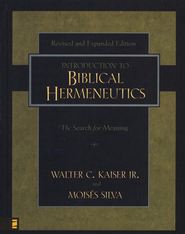
Kaiser, Walter and Silva, Moises,
An Introduction to Biblical Hermeneutics, Zondervan,
April 1994. Click on the link to go to Amazon for more info and
reviews.
Excellent book on the subject of interpreting the Bible.
College level but pretty easy to understand even so. Well written
and thoughtful approach, using the concept of discussion between the two
scholars (who don't agree on everything) to illustrate various truths.
Highly recommended.
Young, Brad H.,
Jesus the
Jewish Theologian, Peabody Massachusetts: Hendrickson Publishers, Inc. web
site also at
Gospel
Research Foundation.
Places the
teaching style of Jesus in context with His contemporaries.
Excellent book. See "The Parables" under Interpretation for a
little more general information on Brad.
Blech, Rabbi Benjamin.
The
Complete Idiot's Guide to Understanding Judaism, New York, NY: Alpha
Books, 1999.
Very
readable, basic book on understanding Judaism. Or should we say
Judaisms? Rabbi Blech does a good job presenting a fairly
complicated subject in a straightforward, humorous manner. If you
need to sort out some differences between sects and beliefs and so on
this is your book.
Bullinger, E.W.,
Number in
Scripture - It's Supernatural Design and Spiritual Significance, Grand
Rapids, MI: Kregel Publications, 1967.
Munk, Rabbi Michael L.
The
Wisdom in the Hebrew Alphabet - The Sacred Letters as a Guide to Jewish
Deed and Thought, Brooklyn, NY: Mesorah Publications, Ltd. Tenth
Printing December 1998.
This book
is best used as a reference rather than for reading straight through,
but very good for helping to understand the deep significance of the
Hebrew aleph-bet. A lot of beautiful information is included.
Spends a lot of time on the background and development of each letter
and why they are so important. There's a lot more meaning there
than the English alphabet.
Hegg, Tim.
The
Letter Writer: Paul's Background and Torah Perspective, Israel, First
Fruits of Zion, 2002.
Currently out of print, but the link above goes to Amazon
and some copies are available used. Tim can
get pretty in-depth when he wants to, and this is one of those books.
He has some presentations under the Letters Conference above, and is an
interesting speaker. This book will help to change some of the
assumptions many Christians make about Paul. You will be surprised
at how different he probably really was than the standard Church idea.
Very dry and sort of hard to plow through, but worth the effort.
Young, Brad H.
Paul
the Jewish Theologian, Peabody Massachusetts: Hendrickson Publishers,
Inc. 1997. Gospel
Research Foundation.
For
comments on Brad's books, see the section titled Interpretation.
New for December 2004.
We were referred to a link that has many excellent articles and other
academic information indexed for the Hebrew Bible, otherwise known as
the Tanakh. It seems to be a good source for many quality works
from a variety of authors, so now we share it with you. We have
not checked this site or it's links completely, so let us know if you
find anything squirrelly. The link is
www.itanakh.org.
Many people nowadays are disparaging theology,
proclaiming from the pulpit that it is not necessary for the believer.
Considering that the meaning is 'theos' and 'logos' or 'God speaks' or
even 'God's Word,' the attempt to eliminate it from the believer's walk
is strange. Philosophy, on the other hand, which is merely men's
opinions, could and should be suspect, including the philosophy that
God's Word should be kicked out of the church. It is when theology moves
away from the Word and into philosophical realms that theology looses
its relevancy for any believer's life. Here are some books that
put the relevancy back into 'God Speaking' and help the believer to
understand basic issues.
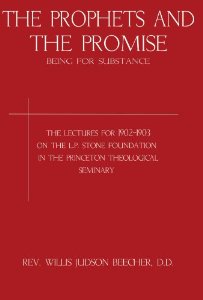
Beecher, Willis Judson, The Prophets
and the Promise, Kessinger Publishing LLC, June 2006, 444 pages.
This book was originally a series of lectures given by
Beecher in 1902-1903. When it was first published the book title
was 'The Prophets and the Promise, Being for Substance; The Lectures
1902-1903.' This shows that Promise Theology is not a new thing,
and Mr. Beecher shows how the Prophets take up the theme of the promise
given in the Pentateuch and reinforce it in many ways. A little
dry, but it will help give you one of the keys for understanding the
whole of the Word. Highly recommended.
Kaiser, Walter C. Jr., Toward an Old
Testament Theology, Zondervan, September 1991, 320 pages.
Excellent, excellent book written around the idea that
the promise of God is the central theme of the Bible. Of course,
the promise is also the Messiah Jesus. Promise Theology is
starting to replace the inadequate ideas of both Covenant Theology and
Dispensationalism. Good starting point for rebuilding a believer's
world view torn down by standard church dogma.
Here we present links that will help with looking at different
translations and comparing them. The first link was referred to us
by Shari F. and we thank her for her work in finding it and telling us
about it. Click on
www.tyndale.cam.ac.uk/Scriptures/IB.htm and look at the bottom of
the page. There are articles on different issues with extensive
comparisons and some commentary. This seems to be an excellent
source for looking at what different versions say about the same section
of biblical text.
Kaplan, Aryeh. Tzitzith -
Thread of Light, New York, NY: National Conference of Synagogue
Youth/Union of Orthodox Jewish Congregations of America, 1984.
Written by
an orthodox rabbi, but really interesting anyway. This is the book
that we used to learn how to tie tzitzit (tseet-tseet) or tassels.
You do not have to tie them this way, but there is a lot of meaning to
the style he explains.
|