Feast of Trumpets
This page last updated:
05/14/2007 10:14 AM
Bruce Scott Bertram
Christian Faith and Practice Through
Yom Teruah
Adonai said to Moshe, "Tell
the people of Isra'el, 'In the seventh month, the first of the month is
to be for you a day of complete rest for remembering, a holy convocation
announced with blasts on the shofar. Do not do any kind of ordinary
work, and bring an offering made by fire to Adonai.'"
(Leviticus 23:23-25 CJB - Complete Jewish Bible)
This is another in a series of articles intended to give basic assistance for
practice to the person who has realized that the blessings of the whole
Bible belong to all who follow the Messiah. Yom Teruah (aka feast of
Trumpets) is one of the three "fall" feasts, along with
Yom Kippur (Day of Atonement) and Sukkot (Sue-coat
or Tabernacles). The time from Yom Teruah (first of the month) to Yom Kippur (tenth of the month) is called
by our Jewish brothers and sisters the "Days of Awe." The month before these two (Elul - 30 days), along with the Days of Awe (total of 40 days) is
also called the "Season of Repentance." During this time
God's people are called to self-examination, repentance, and restoration.
You're probably thinking, what is Yom Teruah (tay-rue-uh)? Well, I'm glad you asked that. Yom Teruah is Hebrew for "Day of the Awakening Blast," and it's one of the seven annual appointments that God makes with His children. It is a day of resting (a Sabbath), of remembering, of gathering or assembly (miqra quodesh,
mee-kraw koe-desh), an offering made by fire, and blowing of trumpets, or as they say in Hebrew, shofars (pronounced pretty much like it's spelled). On this day it is said
by Jewish sages that there is an
'open door' in heaven welcoming the repentant person. Other names for this feast are
'Rosh haShanah' (Head of the Year) and the aforementioned 'Feast of Trumpets.' It is thought by
some Jewish sages that this was the time of Creation, and it used to be the first of the New Year.
God changed the beginning of the year from this month, Tishri, to the month (Nisan) of Passover
(Exodus 12:2). In other words He swapped the first month and the seventh month, so now the month of Passover is the first month of the year.
In true Jewish fashion, however, the calendar year still starts on Tishri 1, while the
'religious' year starts on Nisan 1. The reign of kings in Israel was reckoned by the calendar year, while other years are counted by the religious year. This creates a great deal of confusion when trying to match up timelines in the Bible. But don't worry too much about this unless you are trying to correlate Gentile and Israeli events.
As with most of the feasts or 'festivals,' this celebration involves mostly fellowship and food (with
traditionally lots of sweet stuff), in addition to the various teachings
that go along with it. Boy, you would think that after a while the
Father would get tired of all of this celebrating!
The timing of this feast is a little tricky, because it's the only one
that is supposed to be on the first day of a month (Tishri). The
trickiness is because months don't start until the first bit of light
appears on a new moon, and the moon can stay dark for up to 3 1/2 days.
In ancient times the high priest would listen to testimony from at least
two witnesses who saw that first sliver of light in order to determine
the start of the month (and the feast in this case). Then he would send
word throughout the Land of Israel that it was time to get down, get
funky, and get loose. Because of the time needed for getting the message
out to everybody, this feast is actually two days long, but they are
considered one long day. So, and this is REALLY important, no one would
know the day or the hour that the feast would start. Does this sound
familiar? It should, because Jesus said this exact thing concerning His
return.
"But of that day and hour no one knows, not even the angels of
heaven, nor the Son, but the Father alone."
(Matthew 24:36 NASB)
While any horn or trumpet could be considered a shofar (Strong's number 7782), it is
traditionally an instrument made from the curved horn of a sheep or goat-related animal.
One thought is that to be a proper shofar, it should have at least one bend in it. Another type of trumpet (made from silver and straight) is used for summoning the congregation or signaling camp movement in places such as Numbers 10. The Hebrew word for this type of trumpet is
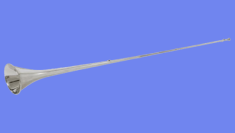
chatsotsrah (khah-tsow-tsraw, Strong's number 2689). In some ways there are specific meanings attached to each type of noisemaker, and in some ways they are interchangeable, depending on what they are used for. For instance, both are mentioned in Psalm 98:6 as a way to make a joyful noise.
With trumpets and the sound of the horn shout joyfully before the King, the LORD.
The shofar was also used as mentioned in Exodus 19:16,19 and 20:18 for a representation of the voice of
God. (Also Psalm 47:5.) Perhaps that's one of the reasons why the walls of Jericho collapsed (ram's horns or shofars are mentioned 14 times in Joshua 6). Shofars were used to sound battle cries (Judges), rally troops (Nehemiah 4:20), or express joy, while trumpets seem to be used more as a calling device or for music (usually joyful), mostly connected to the Tabernacle or Temple. Shofars seem to be mentioned more often than
chatsotsrah (or straight silver trumpets), but that could be because animal horns were easier for the average person to obtain.
Or because battle was more common than worship.
A couple of verses in Jeremiah are very interesting. He seems to say that we are directed to the "good way" by the sound of the shofar,
and this good way is the entire Word of God, including the Law.
Here is what Adonai says: "Stand at the crossroads and look; ask about the ancient paths, 'Which one is the good way?' Take it, and you will find rest for your souls. But they said, 'We will not take it.' I appointed sentinels to direct them; 'Listen for the sound of the shofar.' But they said, 'We will not listen.' So hear, you nations; know, you assembly, what there is against them. Hear, oh earth! I am going to bring disaster on this people; it is the consequence of their own way of thinking; for they pay no attention to my words; and as for my Torah, they reject it."
(Jeremiah 6:16-19 CJB)
Another interesting thing in Jeremiah, that I'm not quite sure about, is in 49:2.
"Therefore behold, the days are coming," declares the LORD, "That I will cause a trumpet blast of war to be heard against Rabbah of the sons of Ammon; and it will become a desolate heap, and her towns will be set on fire. Then Israel will take possession of his possessors," says the LORD.
Jeremiah uses the analogy of an "awakening blast" (teruah) of war. I wonder what this means in view of our holiday of the Awakening Blast?

Shofars may be purchased from a number of different companies; you can find many on the web. They can be classified as two basic models, "ram's horn" and "Yemenite." (Some companies even have the straight silver trumpet.) Usually they are under a heading on the web site of "Judaica"
or gifts. A Yemenite is stretched out long with several curves or
"twists." But a ram's horn is smaller and more compact (like, uh, a
ram's horn). The size of
both the Yemenite and ram's horn shofars are measured following the curves,
so you need a flexible measuring tape. Check out The Shofar Man (www.theshofarman.com)
for many good deals on shofars and other related items.
There are even display stands and bags for them in case you want to take your show on the road. I bought a Yemenite that has three twists or curves, is about 30 inches long
(32" straight tip-to-tip), and cost me about $225.00 a few years ago.
Recently I bought another one from a different company that is
about 47" long (36" straight measurement) and cost about $300.00. I think they are getting a little less expensive as demand goes up and supplies increase. I encourage you to buy at least one and learn how to really
'wail.' You can support Israel in a small way by purchasing from one of the
Messianic or Jewish online shops listed
elsewhere on this site (or others you may know).
Learning to blow the shofar is a little difficult, although kids seem to be able to learn it quickly and adults struggle more. Smaller shofars are more difficult to learn on than larger shofars, but once you learn how you can adapt to almost any size.
Don’t worry if you sound more like a lovesick moose than a professional
shofar player; just honk that horn, baby.
The secret lies in keeping the lips loose enough to vibrate (not like a raspberry- the vibration comes from the interior part of the lip), but firm enough to direct the sound into the shofar.
Usually it helps to place the shofar slightly to the right or left of
the center of your lips. The blowing end is not big like a
trumpet, but just a hole in the end of the horn. There are websites that have examples of the series of sounds used by the Jews for various purposes
(use a search engine), and videos. After lots of practice I can (sort of) get about three
or four different notes out, but a skilled person can almost play a tune (up to five notes).
Other than the Awakening Blast, there is not a great deal of actual specifics
for observing this feast. If you want some Jewish recipes for traditional foods, try searching the web
or you can email us for some recipes. Our Jewish brothers and sisters really know how to cook. There are themes associated with all of the feasts that
are discussed in an article titled "Christian Faith and Practice through Cycles." Relax, enjoy the presence of the Father as you make your
'appointment' with Him, and 'remember' what the Father has done to make
you part of His Kingdom.
And watch out for
the moose.
Your dead will live, my corpses will rise; awake and sing, you who dwell in the dust; for your dew is like the morning dew, and the earth will bring the ghosts to life. Come, my people, enter your rooms, and shut your doors behind you. Hide yourselves for a little while until the wrath is past.
(Isaiah 26:19,20 Complete Jewish Bible)
Shout for Joy
Bruce Scott Bertram
|